Made by hand in our partner workshop in China  ·  Shipped worldwide  ·  Every symbol comes with its sources
Atlas  /  For children  /  Aban (baby-carrier panel)No. 125
Plate ISoutheast Asia · Borneo (Kayan and Kenyah peoples)Aban (baby-carrier panel), drawn by Wishlore
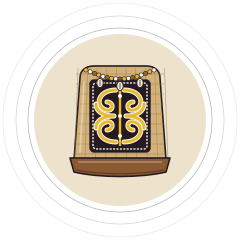
Pl. IAban (baby-carrier panel). A woven baby carrier with a wooden seat; its beaded panel shows simplified yellow-and-white scrolls on black, with no figures, and strings of beads and small shells hang at the top. Drawing: Wishlore.
No. 125  ·  For children  ·  Southeast Asia

The aban

In Borneo, Dayak mothers carried their babies in richly decorated carriers, known in Kayan communities as ba’. At the rear of the carrier, facing outwards, sat a beaded panel called the aban. The Asian Civilisations Museum in Singapore says such decorations were believed to frighten evil away, and that people looked to the aban above all to keep harm from the child.

Earliest record
Kayan or Kenyah panel, late 19th–early 20th century (Asian Civilisations Museum, Singapore)
Source
Asian Civilisations Museum, Singapore (Roots, National Heritage Board), ‘Decorative panel for baby carrier’, 1997-04713
Region
Southeast Asia · Borneo (Kayan and Kenyah peoples)
Wish
For children
Layers
Record Folk Modern
The story · three layers

The story, in three layers.

Record, Folk and Modern are kept apart, and each one carries its source.

I
Record
Late 19th–20th century

Panels from Central Borneo

The Asian Civilisations Museum in Singapore holds two decorative panels, dated to the late 19th or early 20th century, that were once attached to the back of baby carriers. The museum says they were made by Kayan or Kenyah people of Central Borneo, who are well known for highly ornate beadwork, and that the human face on them stands for a guardian spirit watching over the baby. The Horniman Museum in London holds a whole 20th-century Kenyah-Kayan carrier of woven rattan over a wooden base; its glass-bead panel, which the museum calls an aban, shows a heavily stylised human face among curving tendril motifs, with tassels of animal teeth along the top.

To verify: The Metropolitan Museum of Art’s shell-and-bead aban with a pair of ancestor figures (Kayan, 19th–early 20th century), which we could not open for this check

II
Folk
Borneo, late 19th–20th century

Facing outwards

Dayak mothers carried their babies in elaborately decorated carriers, called hawat or benning, and ba’ in Kayan communities. The Asian Civilisations Museum says the carriers were worked with beaded panels and hung with objects thought to carry magic, and that people believed these decorations frightened evil away and encouraged kindly forces. They looked above all to the beaded panel, the aban, which faced outwards from the rear of the carrier.

To verify: The Metropolitan Museum of Art’s fuller account, which we could not open: that the carrier was used when a baby left the longhouse with its mother, that a young child’s soul was thought to wander easily, and that the aban faced spirits coming from behind

III
Modern
Wishlore, today

Our drawing

Aban beadwork is Kayan and Kenyah heritage, so we tell its story and do not copy a panel. The scrolls in our drawing are a simplification, not a copy of any real panel, and the drawing leaves out the human faces and figures that real panels show.

To verify: The Metropolitan Museum of Art’s 1999 press release for Guardians of the Longhouse: Art in Borneo, said to describe baby carriers as status symbols, which we could not open

Aban (baby-carrier panel)
Kayan or Kenyah panel, late 19th–early 20th century (Asian Civilisations Museum, Singapore)
Story and sources on the reverse
Pl. IIThe story card. Every printed piece carries the story and a code that opens the full source list.
Keep it close

How would you like to keep it?

Add to bag · £8
  • No jewellery for this symbol yet; story card and download only
  • Printed cards are made in our partner workshop in China and shipped worldwide
  • Delivery: [UK/EU/US days TBC]; duties shown at checkout
In one breath
A guardian face, beaded on the back of the carrier. Who would you keep it for?