Made by hand in our partner workshop in China  ·  Shipped worldwide  ·  Every symbol comes with its sources
Atlas  /  For your career  /  Ci wara (Bamana antelope headdress)No. 98
Plate ISub-Saharan Africa · Mali (Bamana)Ci wara (Bamana antelope headdress), drawn by Wishlore
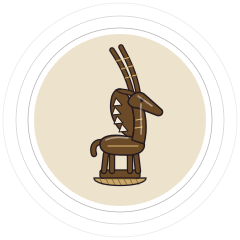
Pl. ICi wara (Bamana antelope headdress). A male ci wara headdress: an antelope with long, swept-back horns and a mane pierced with triangles, fixed to a small basketry cap. Drawing: Wishlore.
No. 98  ·  For your career  ·  Sub-Saharan Africa

Ci wara, the farming antelope

A carved antelope headdress of the Bamana people of Mali. Its name is translated as ‘labouring wild animal’, after a being who, in Bamana tradition, first taught people to farm. It is danced in male and female pairs at sowing and at harvest.

Earliest record
Carved headdresses; pictured in a Paris book of 1917
Source
Wikipedia, Chiwara
Region
Sub-Saharan Africa · Mali (Bamana)
Wish
For your career
Layers
Record Folk Modern
The story · three layers

The story, in three layers.

Record, Folk and Modern are kept apart, and each one carries its source.

I
Record
In European collections by 1917

Headdresses in museum collections

Bamana carvers made ci wara headdresses in several regional styles, and museums hold many of them, among them the Metropolitan Museum of Art. Female headdresses carry a young antelope and have straight horns; male ones have bent horns, and in the upright style of the Ségou region a body cut through with triangles. European collectors took them up early in the 20th century: Wikipedia records that Guillaume Apollinaire and Paul Guillaume printed pictures of ci wara in Sculptures nègres (1917), and the Musée du quai Branly in Paris gave them an exhibition, ‘Ciwara, African chimeras’, in 2006.

To verify: The Met catalogue’s own wording and dates for its ci wara headdresses: we could not open the record; The 1917 book Sculptures nègres itself


II
Folk
Mali, at sowing and harvest

The one who taught farming

In the story, Ci wara, half antelope and half human, came to earth to teach people to sow crops, so he is honoured at sowing and at harvest. The headdresses, fixed to basketry caps, are always danced in male and female pairs; the male dancers leap like antelopes and scratch the earth with their staffs. The chi wara ton society brings the young men together to work the fields at clearing, sowing and harvest, and Stephen Wooten’s study of the custom is titled ‘Antelope Headdresses and Champion Farmers’.

To verify: How Wooten links the headdresses to champion farmers, in his own words; Who dances the headdresses: some museum notes say young men who have proved themselves in the fields

III
Modern
Wishlore, today

Whose sign it is

The ci wara outline is now one of the best-known forms in African art. It remains a Bamana tradition, and the headdresses belong to the people who carve and dance them. We tell it as a sign of the work of the fields, and make no promise about anyone’s career. Any image we show of a real headdress will name the museum and, where known, the Bamana maker.

Ci wara (Bamana antelope headdress)
Carved headdresses; pictured in a Paris book of 1917
Story and sources on the reverse
Pl. IIThe story card. Every printed piece carries the story and a code that opens the full source list.
Keep it close

How would you like to keep it?

Add to bag · £8
  • No jewellery for this symbol yet; story card and download only
  • Printed cards are made in our partner workshop in China and shipped worldwide
  • Delivery: [UK/EU/US days TBC]; duties shown at checkout
In one breath
Danced in pairs at sowing and harvest, for the one who taught farming. Who would you keep it for?