Made by hand in our partner workshop in China  ·  Shipped worldwide  ·  Every symbol comes with its sources
Atlas  /  For love  /  Lakota courting flute (siyotanka)No. 117
Plate INorth America & Arctic · Lakota, Great PlainsLakota courting flute (siyotanka), drawn by Wishlore
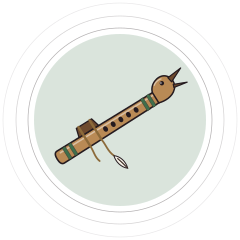
Pl. ILakota courting flute (siyotanka). A long wooden flute with five finger holes and painted bands, a block tied on near the mouth end with a leather thong and a small feather, and the far end carved as a bird’s head with an open beak. Drawing: Wishlore.
No. 117  ·  For love  ·  North America & Arctic

The courting flute

A Lakota suitor could court with music. Carnegie Magazine wrote in 1998 that a young man’s love song on the flute copied a bull elk bugling for a mate, and that flutes were decorated with drawings of elk. In 1918 John R. Colhoff of Pine Ridge carved and painted one in the shape of a crane.

Earliest record
Charles A. Eastman, Indian Boyhood, 1902 (a Santee Dakota account of the Sioux flute)
Source
Charles A. Eastman, Indian Boyhood (Project Gutenberg eBook 337)
Region
North America & Arctic · Lakota, Great Plains
Wish
For love
Layers
Record Folk Modern
The story · three layers

The story, in three layers.

Record, Folk and Modern are kept apart, and each one carries its source.

I
Record
1902 and 1918

Flutes at night

The oldest account we could open was written by a Santee Dakota, one of the Sioux peoples alongside the Lakota. In Indian Boyhood (1902), Charles A. Eastman recalled his first years among the Sioux: young men played the carved flute late into the night for young women to hear, their robes pulled over their heads. The oldest Lakota flute we could check is a courting flute of 1918 by John R. Colhoff, born on the Pine Ridge Reservation to a Lakota mother. The Museum of Nebraska Art says he carved and painted it in the shape of a crane, a bird found in Sioux lore, and lists it as cedar with brass beads, cotton cord, hide and paint.

To verify: A Lakota courting flute of about 1870 with a calling elk carved into it, listed by The Metropolitan Museum of Art, which we could not open for this check


II
Folk
19th century

The elk’s love song

Kathryn M. Duda, writing in Carnegie Magazine in 1998 about a Lakota courting scene prepared for the Carnegie Museum of Natural History, says a suitor playing a love song on the flute copied a bull elk that bugles to bring a mate his way. Young men admired the elk’s success with females and hoped to take on a little of it, she writes, so they carried love charms of elk horn, wore clothing with images of the elk and decorated their flutes with drawings of elk. The songs were believed to be irresistible to young women and were said to be composed by a shaman following instructions received in a dream. The Museum of Nebraska Art adds that after marriage a husband would play the flute for his wife.

To verify: An Oglala Lakota man’s courting flute in the form of a bird, from Pine Ridge, in the Smithsonian’s National Museum of the American Indian (117892), which we could not open for this check

III
Modern
1998 and today

A courting scene in Pittsburgh

In 1998 the Carnegie Museum of Natural History in Pittsburgh prepared a Lakota courting scene for its new Alcoa Foundation Hall of American Indians. It was modelled on a ledger drawing by the Lakota artist Thomas Red Owl Haukaas, with a courting flute close by and a recording of a Lakota love song played by the flute maker and musician Brian Akipa. Wishlore editorial note: the courting flute is Lakota heritage, so we tell its story but do not make it.

Lakota courting flute (siyotanka)
Charles A. Eastman, Indian Boyhood, 1902 (a Santee Dakota account of the Sioux flute)
Story and sources on the reverse
Pl. IIThe story card. Every printed piece carries the story and a code that opens the full source list.
Keep it close

How would you like to keep it?

Add to bag · £8
  • No jewellery for this symbol yet; story card and download only
  • Printed cards are made in our partner workshop in China and shipped worldwide
  • Delivery: [UK/EU/US days TBC]; duties shown at checkout
In one breath
A love song in the voice of a bull elk. Who would you keep it for?