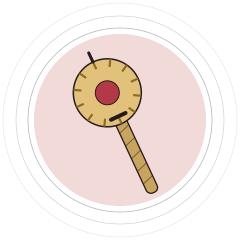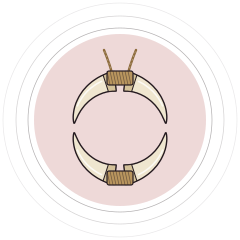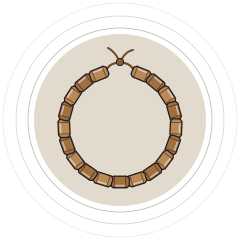
Pieces of wood worn on the neck
John William Colenso, Bishop of Natal, published his Zulu–English Dictionary in 1861. Under isiqu it gives iziqu as “pieces of wood, &c., worn as charms upon the neck of a man”. The fourth edition of 1905, edited by his daughter Harriette Colenso, adds “after he has killed or hlomula-ed a man in battle”; the same dictionary explains hlomula as stabbing a buck “in the second place, after another has stabbed it”. A. T. Bryant’s Zulu–English dictionary, also of 1905, gives isiqu, among other senses, as a medicine kept for emergencies, including the kind worn as a necklace, or as a string round the body, by a warrior who had killed a man in battle; Bryant thought the name probably came from such medicines usually being kept as little chopped-off pieces.
To verify: A dated museum example: the Pitt Rivers Museum, Oxford, is reported to hold a necklet of wooden beads collected by 1897 and identified as a Zulu valour award, but we could not open the museum’s record