Made by hand in our partner workshop in China  ·  Shipped worldwide  ·  Every symbol comes with its sources
Atlas  /  For courage  /  Tuareg stone armringNo. 114
Plate ISub-Saharan Africa · Tuareg of Niger and the central SaharaTuareg stone armring, drawn by Wishlore
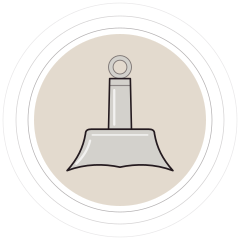
Pl. ITuareg stone armring. A flat ring of black stone, seen at a slight tilt, with a low raised collar round its opening, after an armring from Agadez in the Horniman Museum, London. Drawing: Wishlore.
No. 114  ·  For courage  ·  Sub-Saharan Africa

The Tuareg stone armring

A flat ring of dark stone, worn by Tuareg men on the upper arm, just above the elbow. In 1864 an explorer wrote that Tuareg men said it gave the arm more strength for a sword stroke. A London museum’s record of one from Agadez notes that its collector was told it gives the wearer courage.

Earliest record
Described by the explorer Henri Duveyrier, 1864
Source
Henri Duveyrier, Exploration du Sahara: Les Touareg du Nord (Paris: Challamel aîné, 1864), section “Anneau de pierre au bras” (scan on the Internet Archive)
Region
Sub-Saharan Africa · Tuareg of Niger and the central Sahara
Wish
For courage
Layers
Record Folk Modern
The story · three layers

The story, in three layers.

Record, Folk and Modern are kept apart, and each one carries its source.

I
Record
1864, and again in 1930

A ring taken with the sword

The French explorer Henri Duveyrier wrote in 1864 that every Tuareg man except the marabouts (Muslim holy men) wore a stone ring on his right upper arm from the age when he could take up arms, and never took it off. Its purpose, the Tuareg told him, was to give the arm more strength for a sword stroke. He described the rings as green serpentine. In 1930 the anthropologist C. G. Seligman wrote that at 16 or 17 Tuareg youths began to carry a sword and wear the stone arm-rings, and were then counted full members of their tribe or village.

To verify: The page number of Duveyrier’s section on the stone ring: the scanned contents and page headings disagree.

II
Folk
Aïr, Niger, 1935; Agadez, before 2005

“It gives the wearer courage”

Writing in 1935 and citing the traveller F. R. Rodd, W. D. Hambly said that in the Aïr mountains the rings were first worn when a young man took up the sword, that boys and women were not allowed to wear them, and that the flat rings passed from father to son; some bore a name in Tifinagh, the Tuareg script. The Horniman Museum in London holds a black stone ring from Agadez, dated only “before December 2005”, of the kind worn just above the elbow. Its record says that Ursel Widemann, who collected it, was told that the ring “does not function as an amulet, but gives the wearer courage, i.e. it is more a psychological aid”.

To verify: Hambly is reporting F. R. Rodd’s book People of the Veil (1926), p. 285, which we have not read ourselves.; Who told Ursel Widemann that the ring gives courage, and when: the museum record does not say.

III
Modern
1944 to today

Weapon, ornament or courage

Not everyone thought the ring was for fighting. The ethnographers Henri Lhote (1944) and Johannes Nicolaisen (1963) judged the stone too fragile to serve as a weapon and treated the ring as an ornament. The Horniman’s notes on another Tuareg armlet say that such armlets were given to young men with a sword at a rite of passage, and that stone armlets are very rare nowadays. We tell the ring’s story and make no promise to anyone who wears one: the courage is the wearer’s own.

Tuareg stone armring
Described by the explorer Henri Duveyrier, 1864
Story and sources on the reverse
Pl. IIThe story card. Every printed piece carries the story and a code that opens the full source list.
Keep it close

How would you like to keep it?

Add to bag · £8
  • No jewellery for this symbol yet; story card and download only
  • Printed cards are made in our partner workshop in China and shipped worldwide
  • Delivery: [UK/EU/US days TBC]; duties shown at checkout
In one breath
Not an amulet, the collector was told, but a ring that gives the wearer courage. Who would you keep it for?