Made by hand in our partner workshop in China  ·  Shipped worldwide  ·  Every symbol comes with its sources
Atlas  /  For calm & sleep  /  KomboloiNo. 109
Plate IWestern & Southern Europe · Greece and CyprusKomboloi, drawn by Wishlore
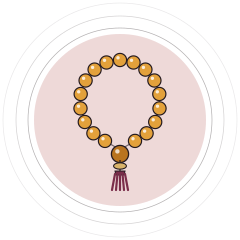
Pl. IKomboloi. A loop of seventeen amber-coloured beads on a cord, joined at a larger head bead, with a small flat shield and a plum tassel below. Drawing: Wishlore.
No. 109  ·  For calm & sleep  ·  Western & Southern Europe

The komboloi

A loop of loose beads, often amber, with a larger bead and a tassel where the ends meet. In Greece and Cyprus people turn it in their fingers and click the beads one by one, to relax or to pass the time. It looks like a string of prayer beads, but it has no religious use: in English it is called ‘worry beads’.

Earliest record
No early record of the worry-bead use
Source
No early record
Region
Western & Southern Europe · Greece and Cyprus
Wish
For calm & sleep
Layers
Record Folk Modern
The story · three layers

The story, in three layers.

Record, Folk and Modern are kept apart, and each one carries its source.

I
Record
Not recorded

No early record found

We found no early written record of people turning a komboloi to pass the time or settle their nerves. The name is usually traced to the knotted Greek prayer rope, but we could not check when the loose-bead komboloi first appeared. If you know an early source, we would like to see it.

II
Folk
Greece and Cyprus, today

Turning the beads

In Greek and Cypriot life the komboloi is used to relax and pass the time, by people trying to smoke less, and as a mark of standing, above all when the beads are silver or amber; some keep one as an amulet against misfortune. A Greek komboloi usually has an odd number of beads, often 17, 19 or 23, with a fixed head bead called the papas, ‘priest’, a shield that keeps the two threads apart, and a tassel. A quiet way to use it is to tip the beads over one at a time, so that each falls and clicks against the shield. The word is traced to komboskini, the Greek prayer rope, but worry beads have no religious purpose.

To verify: These uses and bead counts against a published study: the encyclopedia article we used relies mainly on a Greek collector’s book (Tasos Thomaidis, 2001) and asks for better sources
III
Modern
Wishlore, today

How we tell it

Shops sell the komboloi as a way to ease stress. We tell what people do with it, turning and clicking the beads, and make no claim about nerves or health. Amber is a favourite material, and so is coral; anything we made would say plainly what the beads are made of, and would use no coral.

Komboloi
No early record of the worry-bead use
Story and sources on the reverse
Pl. IIThe story card. Every printed piece carries the story and a code that opens the full source list.
Keep it close

How would you like to keep it?

Add to bag · £8
  • No jewellery for this symbol yet; story card and download only
  • Printed cards are made in our partner workshop in China and shipped worldwide
  • Delivery: [UK/EU/US days TBC]; duties shown at checkout
In one breath
Beads that are not counted, only turned. Who would you keep it for?