Made by hand in our partner workshop in China  ·  Shipped worldwide  ·  Every symbol comes with its sources
Atlas  /  For calm & sleep  /  Ole Lukøje (the Sandman)No. 108
Plate INorthern Europe · Denmark (John Blund in Norway and Sweden)Ole Lukøje (the Sandman), drawn by Wishlore
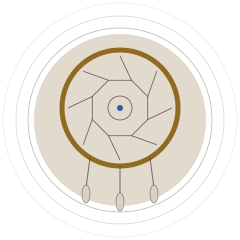
Pl. IOle Lukøje (the Sandman). Two umbrellas: one open and tipped so that we see inside it, four of its panels painted with a moon, a star, a ship and a house; the other closed and plain. Ole himself is not drawn. Drawing: Wishlore.
No. 108  ·  For calm & sleep  ·  Northern Europe

Ole Lukøje, the Danish Sandman

Ole Lukøje, “Ole Shut-Eye”, is the Danish Sandman. In Hans Christian Andersen’s tale of 1841 he comes up the stairs in his socks in the evening, puts a little dust in the children’s eyes, and opens an umbrella with pictures inside over the good ones, so that they dream.

Earliest record
Andersen’s tale, December 1841
Source
Hans Christian Andersen, “Ole-Luk-Oie, the Dream-God”, in Fairy Tales of Hans Christian Andersen (Project Gutenberg eBook 27200)
Region
Northern Europe · Denmark (John Blund in Norway and Sweden)
Wish
For calm & sleep
Layers
Record Folk Modern
The story · three layers

The story, in three layers.

Record, Folk and Modern are kept apart, and each one carries its source.

I
Record
Copenhagen, 1841

Andersen’s Dream-god

Hans Christian Andersen published “Ole Lukøje” in December 1841, in a booklet of fairy tales for children. In an old English translation, Ole “walks in his socks”, throws “very fine dust” in the children’s eyes, and “only wants them to be quiet” so that he can tell them stories. Over good children he opens an umbrella with pictures inside; under the plain one, children sleep without dreaming.

To verify: The publication date (20 December 1841) and the booklet’s title, which we took from Wikipedia and did not check against a Danish first edition


II
Folk
Germanic and Scandinavian folklore

Sand in the eyes

The Sandman is older than Andersen’s tale: E. T. A. Hoffmann’s German story “Der Sandmann” dates from 1816. In Scandinavian folk belief he sprinkles sand or dust into children’s eyes at night to bring sleep and dreams; the grit in your eyes in the morning is said to be his sand. In Norway and Sweden he is called John Blund or Jon Blund, from blunda, “to shut one’s eyes”.

To verify: Walsh’s 1915 entry and the Swedish ABC book, which we know only through Wikipedia; Whether Danish families used the name Ole Lukøje before Andersen’s tale: Wikipedia says the tale draws on a folk tale, but we found no older Danish source

III
Modern
Since 1959, and today

Still at bedtime

The Sandman still arrives at bedtime on screen. Unser Sandmännchen, a stop-motion children’s programme from East Germany based on Andersen’s Ole Lukøje and on Hoffmann’s story, has been broadcast since 1959. We draw Ole’s two umbrellas rather than Ole himself, and we make no promise about sleep: this is a bedtime story to tell, not a remedy.

To verify: The Guardian article on Unser Sandmännchen, which we know only through Wikipedia

Ole Lukøje (the Sandman)
Andersen’s tale, December 1841
Story and sources on the reverse
Pl. IIThe story card. Every printed piece carries the story and a code that opens the full source list.
Keep it close

How would you like to keep it?

Add to bag · £8
  • No jewellery for this symbol yet; story card and download only
  • Printed cards are made in our partner workshop in China and shipped worldwide
  • Delivery: [UK/EU/US days TBC]; duties shown at checkout
In one breath
A storyteller in socks, with an umbrella full of dreams. Who would you keep it for?