Made by hand in our partner workshop in China  ·  Shipped worldwide  ·  Every symbol comes with its sources
Atlas  /  For calm & sleep  /  Shona headrest (mutsago)No. 106
Plate ISub-Saharan Africa · Zimbabwe (Shona)Shona headrest (mutsago), drawn by Wishlore
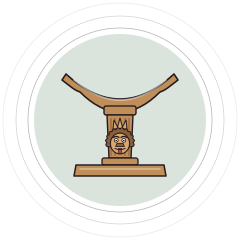
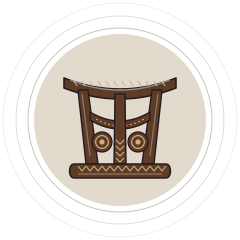
Pl. IShona headrest (mutsago). A Shona-style wooden headrest seen from the front: a curved top bar on two slanting legs and a central post, with two carved concentric-circle bosses and an oval base cut with zigzags. Drawing: Wishlore.
No. 106  ·  For calm & sleep  ·  Sub-Saharan Africa

The Shona headrest

A small carved wooden headrest, called mutsago, on which a Shona man in Zimbabwe rested his head as he slept. The Horniman Museum in London calls such headrests intensely personal objects connected to the ancestral realm: a man often took his with him when he travelled, and at his death it was usually buried with him or passed down to his descendants.

Earliest record
A Shona headrest collected before 1890, now in the British Museum
Source
Horniman Museum and Gardens, London, ‘Carved wooden headrest’, Shona, Zimbabwe, museum number 20.13 (collection record)
Region
Sub-Saharan Africa · Zimbabwe (Shona)
Wish
For calm & sleep
Layers
Record Folk Modern
The story · three layers

The story, in three layers.

Record, Folk and Modern are kept apart, and each one carries its source.

I
Record
Zimbabwe, collected before 1890

Buried with him, or handed down

The Horniman Museum holds a carved wooden Shona headrest from Zimbabwe (museum number 20.13). Its record says that among the Shona, headrests were traditionally used by mature men to keep their hairstyles in place while they slept, and that they were intensely personal and symbolic objects connected to the ancestral realm, usually buried with the owner at his death or passed down to his descendants. Their carving is said to evoke the female form, with two breast-like circles on the support. The record compares this headrest with one in the British Museum (Af1892,0714.26) that J.H.T. Bent collected before 1890.

To verify: The British Museum’s own record for the headrest J.H.T. Bent collected before 1890 (Af1892,0714.26): we know it only from the Horniman’s note and could not open the British Museum’s site; The date of the Horniman headrest itself, which its record does not give

II
Folk
Shona custom, and headrests across Africa

Into the world of dreams

The Horniman Museum says a Shona man’s headrest often went with him when he travelled. An exhibition of headrests from the Fowler Museum at UCLA, shown at SFO Museum, labels its Shona pieces mutsago and dates them to the late 19th or early 20th century. Speaking of headrests across Africa, not of the Shona alone, it says they held up elaborate hairstyles for weeks or months at a time, were often a mark of the owner’s standing, and in Africa and Oceania were also used to invite ancestral spirits into dreams.

To verify: That Shona men were said to visit their ancestors in their sleep, and that Shona diviners or spirit mediums used headrests to seek guidance in dreams: we saw this only in search summaries of the British Museum’s and the Metropolitan Museum of Art’s records, and could open neither; Whether headrests are still used in Shona homes today

III
Modern
Wishlore, today

How we tell it

Headrests like this belong to Shona families and their history. We draw a simple outline for this page only; anything made from it would need Shona carvers and the founder’s agreement. We tell what museums record about the ancestors and dreams, and make no promise about sleep.

Shona headrest (mutsago)
A Shona headrest collected before 1890, now in the British Museum
Story and sources on the reverse
Pl. IIThe story card. Every printed piece carries the story and a code that opens the full source list.
Keep it close

How would you like to keep it?

Add to bag · £8
  • No jewellery for this symbol yet; story card and download only
  • Printed cards are made in our partner workshop in China and shipped worldwide
  • Delivery: [UK/EU/US days TBC]; duties shown at checkout
In one breath
A wooden pillow that went to the grave with its owner, or on to his descendants. Who would you keep it for?